Dear readers, Today, we introduce the large-scale Good Life Data Challenge project, which brings together 32 research teams to identify the determinants of a ‘good life’; let’s discover how our smartphones can now predict our brain health; and explore how a school environment that is inclusive of immigration promotes the success of immigrant pupils. |
|
|
|
|
|
|
COLLABORATIVE PROJECT WHAT IS A GOOD LIFE? 95 RESEARCHERS HAVE TAKEN ON THE CHALLENGE OF ANSWERING THIS QUESTION |
What constitutes a 'good life'? This is a question that interests the general public, policymakers and researchers alike. In an attempt to answer this question, the LIVES Centre is launching the large-scale collaborative project, the 'Good Life Data Challenge'. Thanks to its ambitious and innovative approach, this study could well become one of the most comprehensive investigations into the predictors of a 'good life'. The project brings together 32 research teams involving 95 psychologists, sociologists, demographers and economists from Switzerland, Europe, the United States, China, South Korea and Singapore. The project aims to assess around 30 factors that are likely to influence a sense of having lived a happy, fulfilling and psychologically rich life. |
|
|
|
|
|
|
|
|
CONNECTED DEVICES BRAIN HEALTH: AI PREDICTS OUR EMOTIONAL STATES |
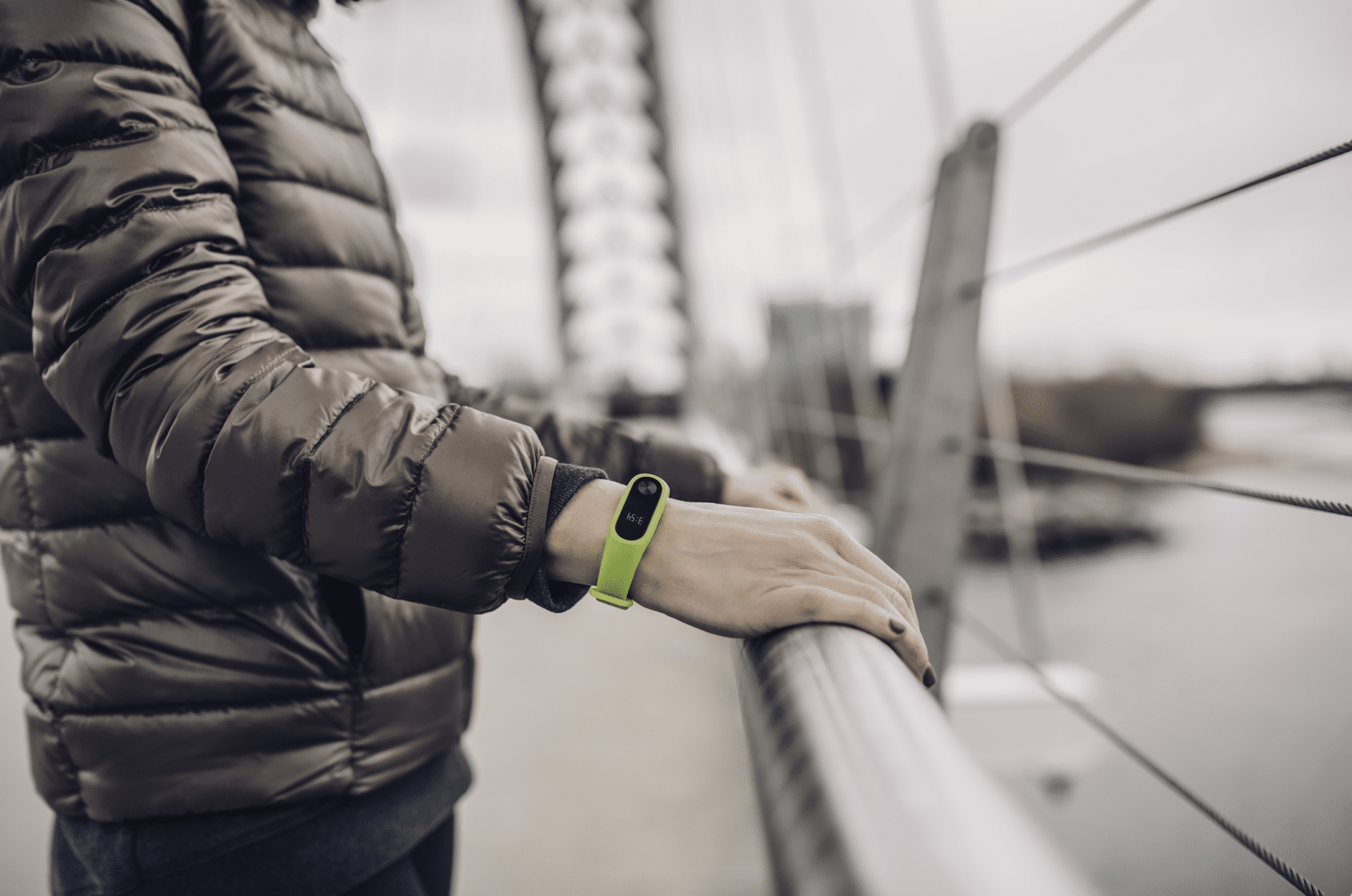
A study from the University of Geneva shows that our smartphones and smartwatches can now predict brain health with remarkable accuracy. By analysing 21 'passively' collected indicators — such as sleep variability, heart rate, weather and air pollution — an AI system can anticipate our cognitive and emotional fluctuations, achieving an average error rate of just 12.5%. Emotional states proved to be the most predictable, with an error margin of between 5% and 10% — better than for cognitive abilities. These results pave the way for the early, non-invasive, personalised detection of neurological or mental health disorders, enabling intervention at the earliest possible stage and taking into account each individual’s lifestyle and environment. Matias, I., Haas, M., Daza, E.J. et al. (2026). Digital biomarkers for brain health: passive and continuous assessment from wearable sensors. npj Digit. Med. 9, 197. https://doi.org/10.1038/s41746-026-02340-y |
|
|
|
|
|
|
|
DISCRIMINATION GENDER-BASED VIOLENCE: A PERSISTENT PROBLEM |
Gender- and sexuality-based violence remains common among apprentices in Switzerland. This worrying finding emerged from a joint study conducted by the University of Lausanne, the University of Geneva, the Canton of Geneva and the HEP Vaud. Female students and LGBTQI+ individuals are particularly vulnerable, especially to verbal and physical abuse. These situations vary by sector and are more prevalent in male-dominated fields. They occur both at school and in the workplace, most often between peers. Given the scale of the problem, the researchers are calling for stronger prevention measures, better support for victims, and a zero-tolerance approach to such behaviour. Blondé, J., Gianettoni, L., Guilley, E., Gross, D. & Foretay, T. (2025). Prevalence of Sex-Based and Sexual Orientation-Based ViolenceExperiences in Vocational Education and Training. Journal of Interpersonal Violence, 0(0). https://doi.org/10.1177/08862605251384951 |
|
|
|
|
|
|
|
|
SCHOOL CLIMATE INCLUSION: A KEY FACTOR FOR SUCCESS AT SCHOOL |
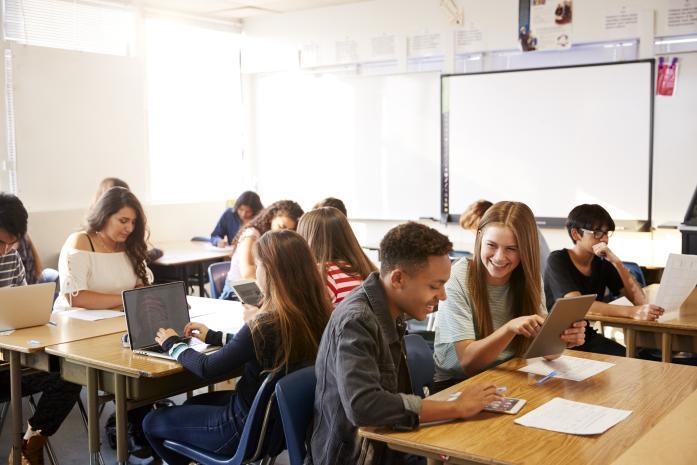
A school environment that is inclusive towards immigrants promotes the success of immigrant pupils, particularly those from the first generation. This is demonstrated by a large-scale international study conducted at the University of Lausanne and covering 1,544 state schools across seven OECD countries. Teachers' attitudes can directly influence pupils' performance and reduce the gap with their non-immigrant peers by nearly one year of schooling. However, the effect is less pronounced among second-generation students. The study also reveals that prejudices extend beyond the individual level and are embedded in school structures. To address this, the researchers recommend providing teachers with training, encouraging collective reflection, and minimising bias in teaching practices. Batruch, A., Sommet, N., & Green, E. G. T. (2026). Teachers’ immigration attitudes and students’ performance. Learning and Instruction, 102, 102303. https://doi.org/10.1016/j.learninstruc.2025.102303 |
|
|
|
|
|
|
|
VERBAL FLUENCY LANGUAGE, THE SECRET MIRROR OF OUR LONGEVITY |
Research into ageing has reached a significant milestone. A study from the University of Geneva, published in the prestigious journal Psychological Science in 2025, reveals that our ability to articulate our thoughts is the most reliable cognitive indicator of longevity. The study shows that verbal fluency is a more reliable predictor of life expectancy than memory or cognitive speed. This finding could transform geriatric practice, as simple verbal fluency exercises, which are occasionally used to assess certain brain injuries, could become a routine tool for the early detection of a generalised decline in the nervous system. Ghisletta, P., Aichele, S., Gerstorf, D., Carollo, A., & Lindenberger, U. (2025). Verbal Fluency Selectively Predicts Survival in Old and Very Old Age. Psychological Science, 36(2), 87-101.
https://doi.org/10.1177/09567976241311923 |
|
|
|
|
|
|
EXHIBITION University of Geneva |
|
|
|
WELCOME TO YOUR FUTURE: CENTENARIANS OF SWITZERLAND |
After stops in Basel and Zurich, the SWISS100 travelling exhibition is coming to Geneva. Although Switzerland is home to more than 2,200 centenarians, this rapidly growing group remains relatively unknown. Who are they, how do they live, and what can they teach us about ageing well? Based on the first national study of centenarians, the exhibition seeks to answer these questions. After Geneva, the exhibition will move to Lausanne, where it will be on display at the Town Hall Forum from 9 June to 4 July 2026. SEU – UNIGE Exhibition Hall, Bd Carl Vogt 66, Geneva | Free admission |
|
|
|
|
ASSISES 2026 FUTUREFAMILIES Geneva |
|
|
|
MENTAL HEALTH IN FAMILIES: PERSONAL NETWORKS AND INSTITUTIONAL SUPPORT |
The 2026 edition of the ‘Assises des familles’ will comprise morning lectures alternating with three afternoon workshops. The workshops will focus, respectively, on children and teenagers, young adults (aged 25 – 40) and parents facing work-life balance challenges. Participants will discuss the issues involved, the forms of support available from families and institutions, and the profile of those affected. The initiatives of associations and proposals from professionals will also be presented. Le Cénacle Hotel, Charles-Martin 17, 1208 Geneva Registration required |
|
|
|
|
SCIENCE-SOCIETY
COLLOQUIUM University of Lausanne |
|
|
|
HOW DOES RESEARCH INFLUENCE POLICY ON AGEING? |
The LIVES Centre is bringing together researchers, policymakers and practitioners for an afternoon dedicated to ageing. This science-society colloquium aims to examine the quality of dialogue between science, policy and practice in the context of future demographic challenges. The first part of the event will feature presentations providing an overview of the current situation, from healthy ageing to end-of-life care. This will be followed by a round-table discussion that will bring together knowledge, needs and concrete actions. University of Lausanne, Internef Building, Room 272 Registration |
|
|
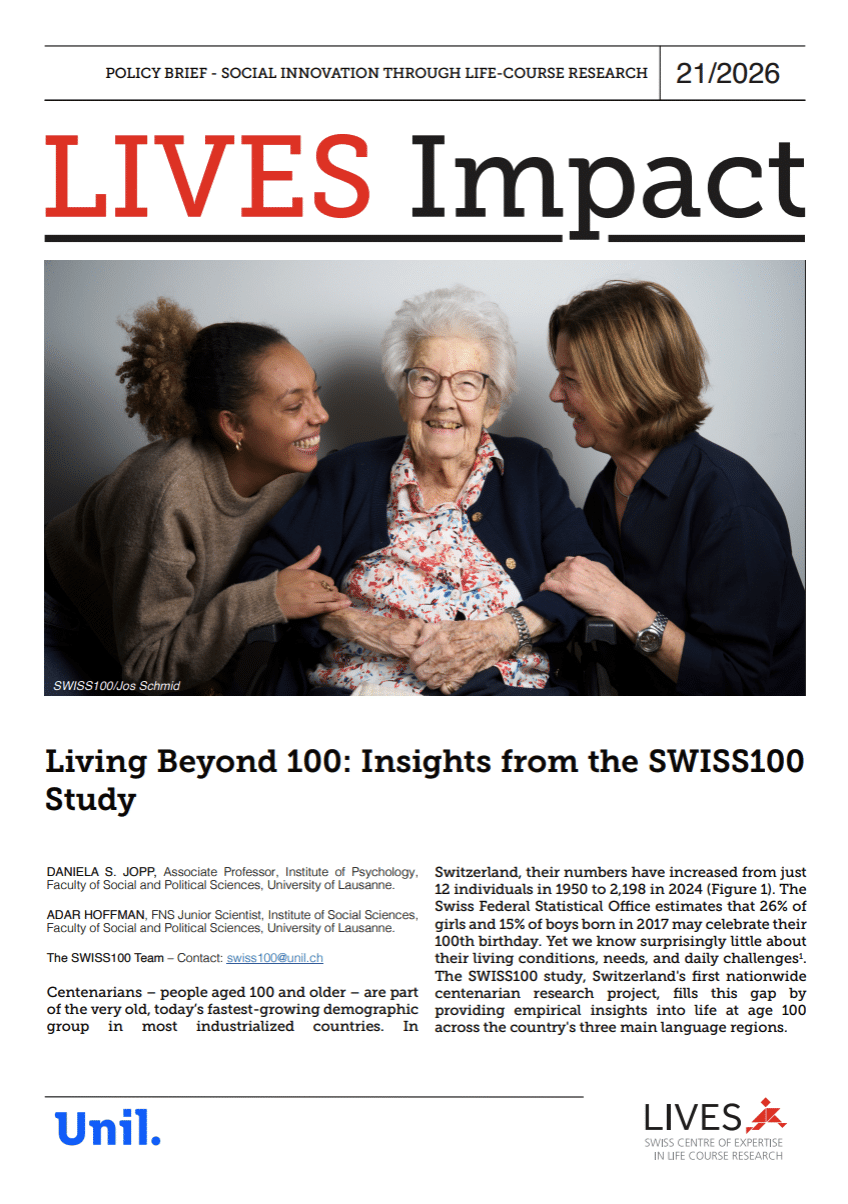
LIVES IMPACT | LIVING BEYOND 100: INSIGHTS FROM THE SWISS100 STUDY |
Centenarians — people aged 100 and older — are part of the very old, today’s fastest-growing demographic group in most industrialized countries. In Switzerland, their numbers have increased from just 12 individuals in 1950 to 2,198 in 2024. The Swiss Federal Statistical Office estimates that 26% of girls and 15% of boys born in 2017 may celebrate their 100th birthday. Yet we know surprisingly little about their living conditions, needs, and daily challenges. The SWISS100 study, Switzerland's first nationwide centenarian research project, fills this gap by providing empirical insights into life at age 100 across the country's three main language regions. |
|
|
|
|
SOCIAL CHANGE IN SWITZERLAND | THE TERM OF TENURE OF SWISS ECONOMIC ELITES |
The average length of time that Swiss CEOs remain in their position has halved over the past 100 years. By analysing 1,377 appointments within the country's 110 largest companies, sociologist Felix Bühlmann of the University of Lausanne and socio-economist Emil D. Böhme of the University of Geneva have shown that the average tenure has fallen by eight years since 1909, standing at 7–8 years today. This trend cannot be explained by the internationalisation of elites, the rise of women in leadership roles or the rise of shareholder capitalism. Rather, the cause lies in the decline of Swiss family capitalism — a fundamental shift that is reshaping the governance of Switzerland’s major companies. Böhme, E. D. & Bühlmann, F. (2026). La durée des mandats des élites économiques suisses, 1890–2020. Social Change in Switzerland, N°43. www.socialchangeswitzerland.ch https://www.socialchangeswitzerland.ch/?p=4667 |
|
|
|
|
Centre LIVES | University of Lausanne | Géopolis Building | 1015 Lausanne | +41216923883 |
|
|
|
You are receiving this newsletter because you have registered on our site or made a purchase. |
|
|
|